
Hickory History in New Zealand
Brothers in Arms, Rivals on the Links: The Enduring Trans-Tasman Battle for the ANZAC Flask at Christchurch Golf Club
As the New Zealand Hickory Open approaches once again in January, a familiar tension begins to simmer on the rolling links of Christchurch Golf Club. It is a tension born not of hostility, but of shared history, a rivalry forged in the mud and chaos of war, tempered on playing fields across generations, and now carried into battle with century old hickory clubs and the steady hands of golfers who revere the game’s origins.
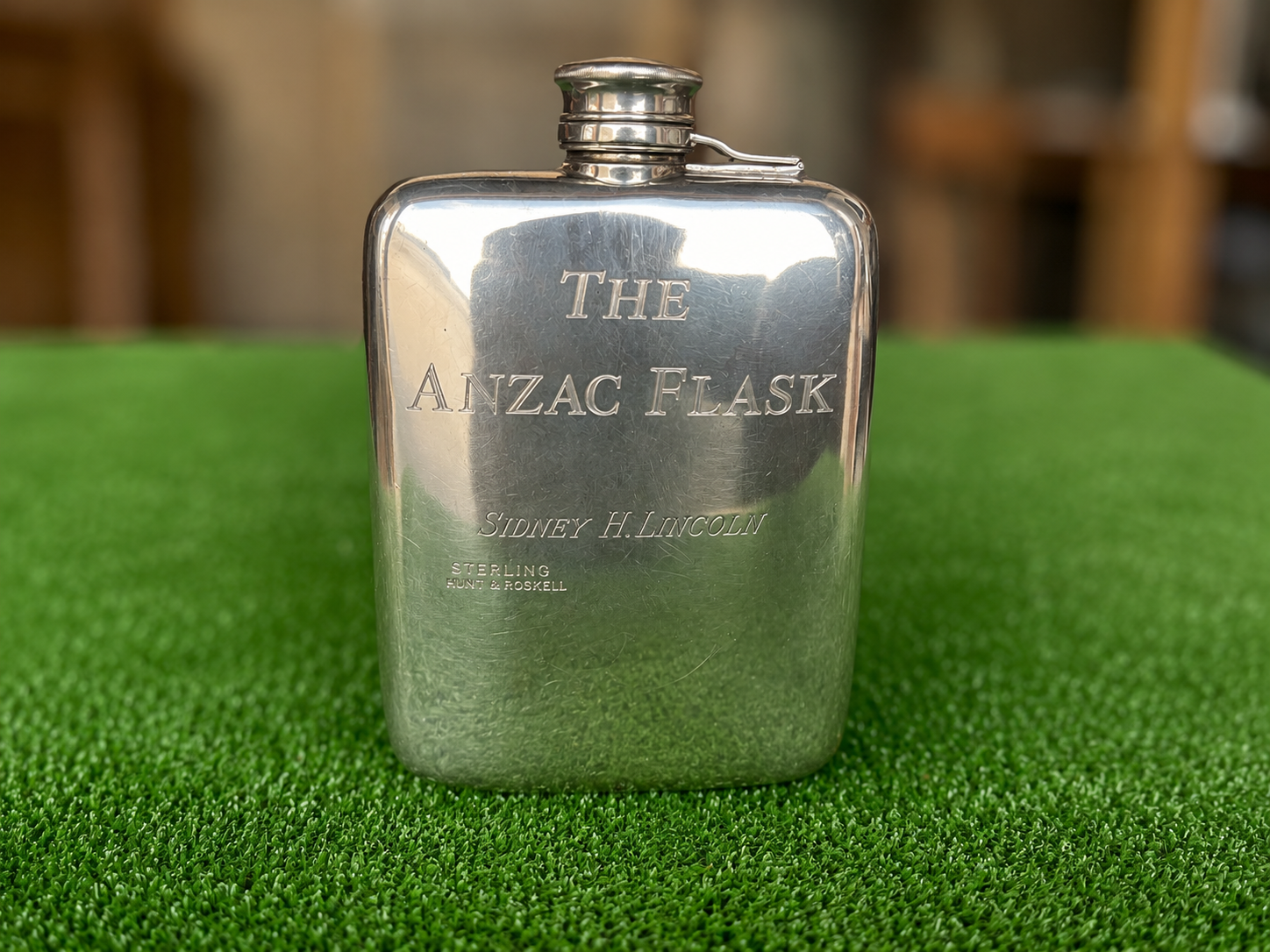
At the centre of this annual contest is an unlikely trophy, a dented, silver-plated 32-ounce whisky flask. Unpretentious, weathered, and yet fiercely coveted, the ANZAC Flask embodies the spirit of the competition. The winning team may hold it aloft, but the losing nation must refill it, with a respectable single malt, of course, ensuring the flask’s journey continues with a full heart and a generous nip to all who want to partake.
A Rivalry Older Than the Trophy
To understand the contest of today, one must travel back further than the first drive struck in a hickory match. The story begins before Gallipoli, when the forces of New Zealand and Australia were combined into the “Australasian Corps.” What seemed like a practical administrative decision stirred a mixture of pride and not so playful resentment among the soldiers. Each nation wanted its identity recognised; each believed, firmly and loudly, that it could outfight, outmarch, and today, certainly outplay the other.
It was here, in the crucible of military brotherhood, that a rivalry was born, one that spilled out onto rugby pitches, cricket grounds, and eventually, the golf course. The ANZAC Flask is a todays symbol, with a nod to the past, of that bond and that competition, two nations united in history, divided only by the length of a well struck hickory shot.
The Contest: Hickory Golf in its Purest Form
Just before the New Zealand Hickory Open each year, the Christchurch Golf Club hosts the ANZAC Flask, a nine hole foursomes match in the morning followed by nine holes of singles in the afternoon. The scoring is straightforward, Stableford points combine from both sessions to produce an aggregate that crowns the victors.
The simplicity of the format belies the intensity of the day. Hickory golf is a discipline that rewards rhythm over power, touch over technology, creativity over precision engineering. Every player steps onto the tee with clubs built a century ago, hickory shafts with their own flex, quirks, tempers, and demands. No two clubs behave alike, and no two shots feel the same.
And so, every stroke matters. A drive hit from the screws feels like a triumph. A wedge that checks, a long iron that holds its line, or a putt that tumbles obediently into the cup, these become moments to savour. As Australian captain Al Grieve once put it “When we play steel, we think of the shots we missed. With hickory, we celebrate the shots that came off…… because we had to work for them.”
The Players: Champions, Characters, and Contenders
Australia first fielded a lineup with enviable depth. Hickory veterans like Darron Watt, Bruce Collins, Alan Grieve, and Dave Mansfield bringing decades of experience and multiple titles across WHOs, state championships, and national events. They arrived as the benchmark, the team with history, structure, and the weight of expectation.
New Zealand’s early challenge was marshalling a squad capable of matching that pedigree. With only one local competition behind them, players such as Mark Lawson, John Rowland, Stephen Ward, and Simon Forshaw rose to meet the moment. Collectively, with the result they delivered in face of such competence, they transformed the mindset of the Kiwi side shifting from determined underdogs into a polished, disciplined unit capable of going putt to putt with their Australian counterparts.
Australia claimed the inaugural ANZAC Flask, with Sir Bob Charles presenting the trophy to Al Grieve in a scene as dignified as it was symbolic. But New Zealand has since rallied, capturing the last two contests, both by narrow margins and both on home soil, where local knowledge is a subtle but meaningful advantage.
A Clash of Equals
This coming year the stage is set for the most compelling chapter yet. Both nations are sending their strongest lineups. Two time NZHO champion Anthony Doyle takes his place among the leaders of the New Zealand team, while Al Grieve returns to Christchurch — a course he considers a spiritual home, ready to lead Australia’s charge with trademark grit and good humour.
Pride will be on the line. Honour will be contested. Bragging rights will be vigorously protected for another year.
But beneath it all lies something far deeper, the echo of two nations whose sons once stood shoulder to shoulder in war, now competing with the same mateship and mutual respect on the fairways. The ANZAC Flask is as much a celebration of that bond as it is a contest of skill.
More Than a Trophy
As the final groups walk up the last hole and the tension tightens with every step, the atmosphere becomes electric. Every point counts, every putt matters. And yet, at day’s end, the handshakes are warm, the laughter is genuine, and the banter begins even before the scoresheets are tallied.
For in the battle for the ANZAC Flask, competition is fierce, but camaraderie always triumphs.
The next edition promises to be the finest yet, a blend of tradition, rivalry, and shared heritage. Whether the flask travels west across the Tasman or stays nestled in New Zealand for another year, one thing is certain the spirit of brotherhood that links both nations will shine brighter than ever.